
'Market corrections are a natural part of investing, so it's essential to remain focused on long-term financial goals.'

'The problem is that the bubble may not only be in valuations, but also in investors' minds.'

Industry players said the sharp sell-off in February forced many companies to put off their listing plans

Stock market investors became richer by a whopping Rs 77.66 lakh crore in 2024, helped by an overall optimistic trend in equities, where the BSE Sensex surged over 8 per cent. Analysts said the year witnessed a tug of war between the bulls and bears marked by volatility but, despite the uncertainties around the world, the Indian markets sustained the pressure and delivered impressive returns.
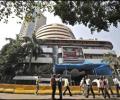
Brokers said selling pressure goatherd momentum as the weakening rupee fell to an all-time low of 54.46 against the US dollar.

The rupee resumed lower at Rs 53.54/55 per dollar on the Interbank Foreign Exchange, as against its previous close of Rs 53.23/24 per dollar, and declined further to a record low of Rs 53.80 against the American currency before quoting at Rs 53.60/61 per dollar at 1030 hours.

'As the global economy undergoes significant transformations in 2025, India's ability to navigate the complexities of trade wars, financial realignments, and emerging blocs will be pivotal,' explain Harsh V Pant and Soumya Bhowmik.
The Indian rupee dropped by 58 paise to a lifetime low of Rs 52.73 per US dollar in early trade on Tuesday on persistent demand for the American currency from banks and importers amid sustained foreign capital outflows from the equity market.

India's stock markets corrected recently but foreign money is likely to chase China rather than India in the short-to-medium term, said Chris Wood, global head of equity strategy at Jefferies, on Thursday. Wood told the Business Standard Manthan Summit in New Delhi he is bullish about Indian equities from a long-term perspective, but for the short term he is cautious given the quantum of foreign investor (FII) outflows and valuation woes.

Equity benchmark Sensex on Monday crashed about 1,546 points to sink below the 58,000-level due to across-the-board selloff tracking sluggish global markets. Besides, persistent foreign capital outflows continued to affect the market sentiment, traders said. Benchmark indices started the session on a weaker note and the selling intensified during afternoon trade, with almost all sectoral indices ending in the red. The 30-share BSE Sensex ended 1,545.67 points or 2.62 per cent lower at 57,491.51.

Shares worth over Rs 50,000 crore (or approximately $6 billion) are set to become freely tradable between now and April 10. Historically, such substantial volumes have been absorbed by a buoyant block-deal market.

Credit card payments for foreign travel will be brought under the purview of the Liberalised Remittance Scheme (LRS) of the Reserve Bank, to ensure that such expenses do not escape TCS (Tax Collection at Source). While moving the Finance Bill 2023 for consideration and passage in the Lok Sabha on Friday, Finance Minister Nirmala Sitharaman said the Reserve Bank has been asked to look into ways to bring credit card payments on foreign tours under the LRS. "It has been represented that payments for foreign tours through a credit card are not being captured under the Liberalised Remittance Scheme (LRS) and such payments escape tax collection at source (TCS)," she said.
Zomato emerged as the biggest gainer, followed by Reliance, Nestle, Asian Paints and Power Grid.

From the Sensex pack, Reliance Industries, Bajaj Finserv, HDFC Bank, Adani Ports, Maruti Suzuki India, Axis Bank, Hindustan Unilever, Sun Pharmaceuticals and Asian Paints were among the laggards. Reliance Industries fell the most by 2.38 per cent to close at Rs 1,171.10 apiece.

618 companies were part of the billion dollar club when the markets reached all-time highs on September 26, 2024. That number has fallen to 500 following a $1 trillion wipeout in India's market capitalisation amid relentless selling by FPIs.

The rupee plunged 20 paise to close at an all-time low of 78.13 against the US dollar on Monday, as a lacklustre trend in domestic equities and stronger greenback overseas weighed on investor sentiments. Forex traders said weak Asian currencies and persistent foreign capital outflows were the other major factors that dragged the local unit down. At the interbank foreign exchange market, the local currency opened at 78.20 and witnessed an intra-day high of 78.02 and a low of 78.29 against the US dollar.

After two months of net outflow, foreign investors turned buyers in June, infusing Rs 26,565 crore in Indian equities, driven by political stability and a sharp rebound in markets. Looking ahead, attention will gradually shift towards the budget and Q1 FY25 earnings, which could determine the sustainability of FPI flows, Vipul Bhowar, Director, Listed Investments, Waterfield Advisors, said.

From the 30-share Sensex pack, Tech Mahindra, HCL Technologies, Tata Consultancy Services, Asian Paints, Infosys and Maruti Suzuki were the biggest laggards.

From the 30-share blue-chip pack, Bharti Airtel, Power Grid, Bajaj Finance, Nestle, Mahindra & Mahindra, Reliance Industries, Asian Paints, IndusInd Bank, Hindustan Unilever and HDFC Bank were the biggest gainers. Bajaj Finance climbed nearly 2 per cent after the company reported an 18 per cent increase in its consolidated net profit to Rs 4,308 crore for the December quarter.

'Within India, people want high-quality, personalised banking services, and the demand for such services has exploded.'

A sharp fall in the equity market made investors poorer by Rs 5.29 lakh crore on Tuesday when the BSE benchmark Sensex tumbled over 800 points. A host of negative triggers -- muted quarterly earnings, continuous foreign fund outflows and weak trends in Asian and European markets -- dragged the benchmark indices lower. The BSE benchmark gauge tumbled 820.97 points or 1.03 per cent to settle at 78,675.18.

Benchmark indices started the trade on a weak note on Wednesday with the Sensex falling 564.77 points, following feeble global market trends and persistent foreign capital outflows. The 30-share BSE Sensex was trading 564.77 points lower at 52,612.68. The NSE Nifty dipped 162.4 points to 15,687.80. Among the Sensex pack, IndusInd Bank, Hindustan Unilever, Bajaj Finserv, Titan, Kotak Mahindra Bank and Bajaj Finance were the major laggards in early trade.

HDFC Bank was the top loser in the Sensex pack, shedding over 3.5 per cent, followed by Bajaj Finance, L&T, HDFC, Bajaj Finserv, HDFC and Kotak Bank.

From the 30-share Sensex pack, Infosys, ICICI Bank, Kotak Mahindra Bank, Mahindra & Mahindra, State Bank of India, HCL Technologies, Axis Bank, NTPC and HDFC Bank were among the laggards. In contrast, Maruti, IndusInd Bank, Adani Ports, ITC and UltraTech Cement defied broader market trends and ended in positive territory.

Among the Sensex firms, HCL Technologies fell the most by 2.4 per cent. IndusInd Bank (2.35 per cent), Infosys (2.28 per cent), Wipro (1.8 per cent), NTPC (1.71 per cent), Asian Paints (1.7 per cent), Tata Consultancy Services (1.36 per cent),Tech Mahindra (1.03 per cent) and SBI (1 per cent) were among the major laggards.
The Rupee on Thursday breached the 49-mark against the US dollar and fell by 52 paise in early trade following increased capital outflow by foreign funds due to melting stock markets.

In January, SIP account closures surpassed new registrations for the first time.

The rupee is under pressure for the past one week.

While India won't be immune to global spillovers, we need to create the macro preconditions for sustained growth. Policy agility, prudence, and resilience will be key, suggests Sonal Varma.
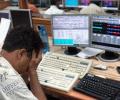
Investors' wealth tumbled Rs 86,741.74 crore on Wednesday, mirroring weakness in the global equity markets amid escalating tensions between Russia and Ukraine. The BSE benchmark Sensex slumped 1,227.18 points to 55,020.10 during the day in line with a global selloff. It finally settled at 55,468.90, lower by 778.38 points or 1.38 per cent. Surging crude prices and foreign capital outflows also weighed on investor sentiment.

The exports in 2022-2023 was $79 billion, compared to imports of $50 billion.
Equity benchmark Sensex slumped over 1,000 points to sink below the 55,000-level on Friday, tracking deep losses in IT, finance, banking and energy stocks amid widespread selling in the global markets. A weak rupee, surging crude prices and relentless foreign capital outflows further weighed on sentiment, traders said. The 30-share BSE index ended 1,016.84 points or 1.84 per cent lower at 54,303.44.

M&M was the biggest loser in the Sensex pack, declining nearly 3 per cent, followed by TCS, Bajaj Finance, Wipro, Kotak Bank, Tech Mahindra, HCL Tech and Tata Motors. In contrast, Titan, Bharti Airtel, ICICI Bank and L&T were among the gainers, rising up to 0.93 per cent.

The broader NSE Nifty, after slipping below the 10,500-mark to hit a low of 10,477, finally concluded 29 points, or 0.27 per cent, down at 10,524.

India recorded a current account surplus of $5.7 billion or 0.6 per cent of GDP in the March quarter, the Reserve Bank of India said on Monday. This is the first time in ten quarters that the crucial metric of the country's external strength has turned into surplus mode. In the year-ago period, the current account deficit stood at $1.3 billion or 0.2 per cent of GDP, and the same was $8.7 billion or 1 per cent of GDP in the preceding quarter ending December 2023.

Indian capital markets joined the global sell-off sparked by China growth concerns

Foreign portfolio investors (FPIs) have net sold domestic shares worth over $10 billion so far this month amid a shift to China, which not only offers attractive valuations compared to India but has also announced several measures to support the economy and the stock market in recent weeks. If the trend doesn't reverse, this will be the first time that overseas funds will yank out more than $10 billion from Indian equity markets in a month.

HCL Tech was the top loser in the Sensex pack, skidding over 4 per cent, followed by Tech Mahindra Dr Reddy's, Wipro, TCS, Titan and Infosys. NSE Nifty plunged 167.80 points to 17,110.15.

The Reserve Bank of India's (RBI's) interest rate decision, West Asia conflict and trading activity of foreign investors are the key factors that will dictate investors' sentiment in the market this week, analysts said. Moreover, quarterly earnings from IT bellwether TCS, domestic macroeconomic data and movement in global oil benchmark Brent crude would also guide trends in the market. Worsening tensions in the Middle East and foreign fund outflows were the major culprits behind the equity markets sharp fall last week.

'The biggest near-term risk to Indian equities is the outflow of investments to China as tactical trades by foreign investors.'
